The Four Places I Kept Covering Up — and the Mirror Test That Explained Why
I skipped three summers of swimming because of my arms. A friend nine years older than
me sat down at the poolside, held up a small mirror, and asked one question that made every firming cream I
had ever bought make sense.
By Jessica LundgrenReader account · 8 min read
My six-year-old granddaughter tugged my hand and asked me to come in the pool. It was July, it was ninety-one
degrees, and every other adult was already in the water. I gave her the same excuse I had given her the
previous summer — that Grandma didn't want to get her hair wet — and she accepted it the way small
children do, with no suspicion at all, and ran back to the shallow end.
I pulled my cardigan tighter. In July. My hair had nothing to do with it.
It was my arms. The loose, papery skin on the insides of them that shifted whenever I reached for anything.
The thin, lined skin across my chest that I kept behind high necklines. The backs of my hands, which I folded
into my lap so nobody could study them. I was 59. From the neck down I felt closer to 75.
Three summers of skipped pools, skipped beaches, skipped sleeveless tops and skipped photographs. Then Grace
sat down next to me.
Grace is 68 — nine years older than me — and she was wearing a sleeveless linen dress with her
arms completely bare. Smooth. Firm. Not shiny, not stretched, not the strange taut look you sometimes see.
Just the arms of a woman who had somehow sidestepped the crepey skin the rest of us are told to accept.
She followed my eyes to the pool, where my granddaughter was waving at me, and said something I still
remember exactly.
“You know we don't do this to ourselves, right? Sit on the edge and hide.”
Grace, 68
I assumed she was about to name a dermatologist, or a procedure, or one of those six-hundred-dollar devices
that get used twice and then live in a bathroom drawer. She didn't. She gave me a test instead — and
that test is the reason I finally understood why every firming cream I had bought had quietly failed.
The test she made me do first
“Hold out your left arm.” I laughed, because I thought she was joking. She wasn't. So I held it
out between us, and she pulled a small mirror from her beach bag and had me turn my arm one way and then the
other while the sun caught the skin.
“Now look at the four places you keep covering,” she said.
01
Inner upper arm
The skin that moves when you reach — and the reason the cardigan stays on in July.
02
Chest & décolletage
Fine vertical lines that show above every neckline you own, and never quite fade.
03
Backs of the hands
Thin, papery, and the first thing anyone sees when you pass them something.
04
The neck
Horizontal creases that deepen year by year while every product you own goes on your face.
“What do all four have in common?” she asked. “They're old?”
I said. “No,” she said. “They're under-supported.”
That wasn't the answer I expected. Grace's point was that most of us treat crepey skin as one problem —
we see a loose arm or a lined chest, reach for something that promises to boost collagen, and wait. But what
we're looking at is three separate changes arriving together:
One: the skin keeps folding in the same places, so the creases set. Two:
the deeper support that once made it thick and resilient weakens. Three: the surface loses
moisture faster, which makes every line look sharper and every area look thinner.
“You're trying to fix a bent cushion by polishing the cover.”
That sentence landed, because it described precisely what I had been doing for years: buying one surface
product after another for a problem showing up in the surface, the structure, and the way my skin
held water.
Why the Korean approach was different
I had always assumed Korean women simply had better skin — better genes, different food, a kinder
climate. Something to admire and not reproduce. Grace shook her head at that. What she had read, she said,
wasn't about genetics at all. It was about the tools.
While a great deal of Western skincare has concentrated on adding moisture to the very top of the skin,
Korean formulation labs spent decades on peptides — short chains of amino acids designed to signal
deeper into the skin rather than sit on it. The goal was never only a smoother-feeling surface. It was to work
on the three things Grace had just shown me in the mirror: the look of repeated creasing, the underlying
support, and the barrier that keeps moisture where it belongs.
“It isn't magic,” she said. “It's just more complete.” Her analogy was a worn piece
of fabric: first you soften the fold, then you reinforce the material, then you protect it so it doesn't dry
out and start folding again.
Then she showed me the jar she had been using for a year.
What was actually in the jar
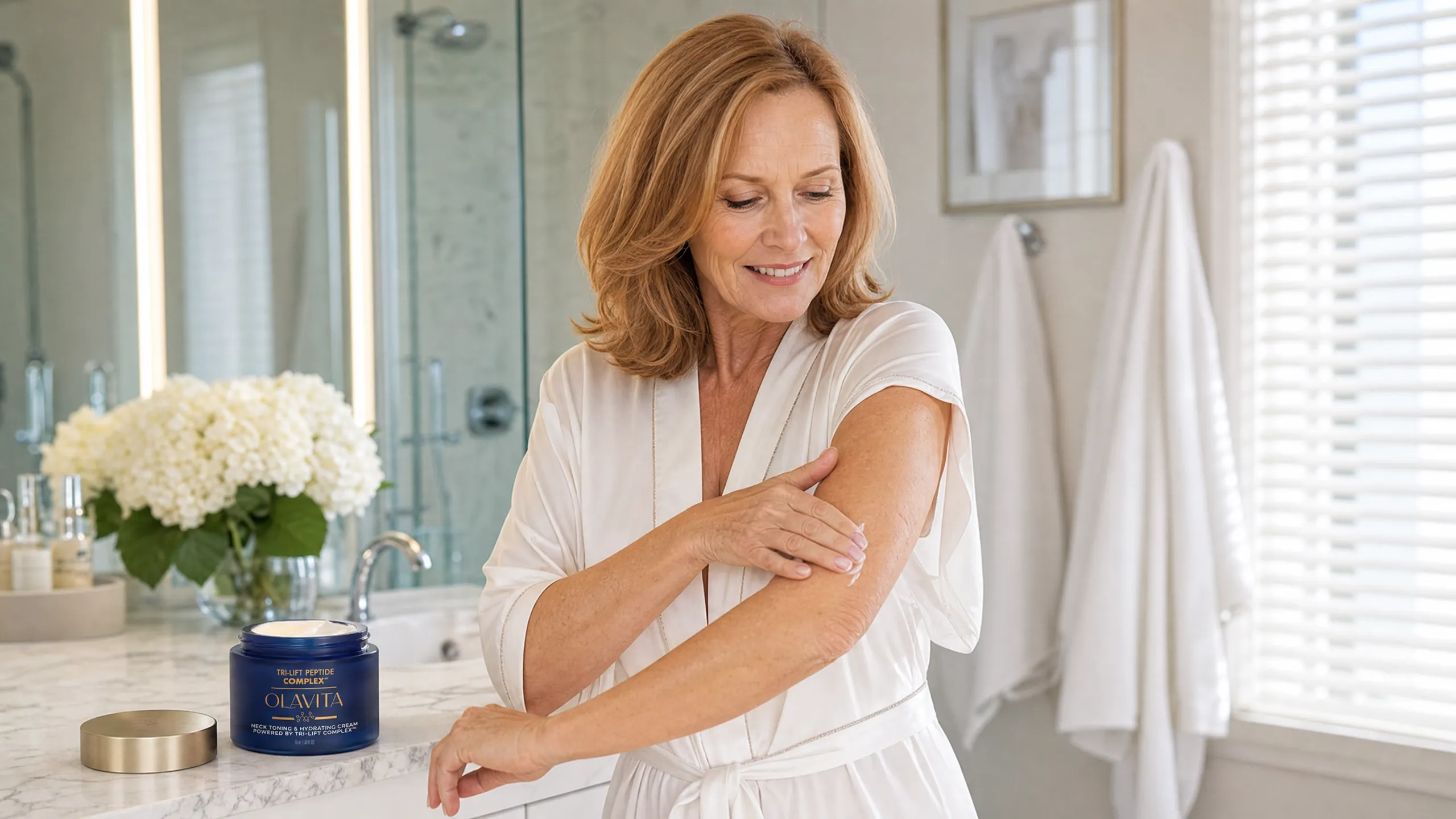
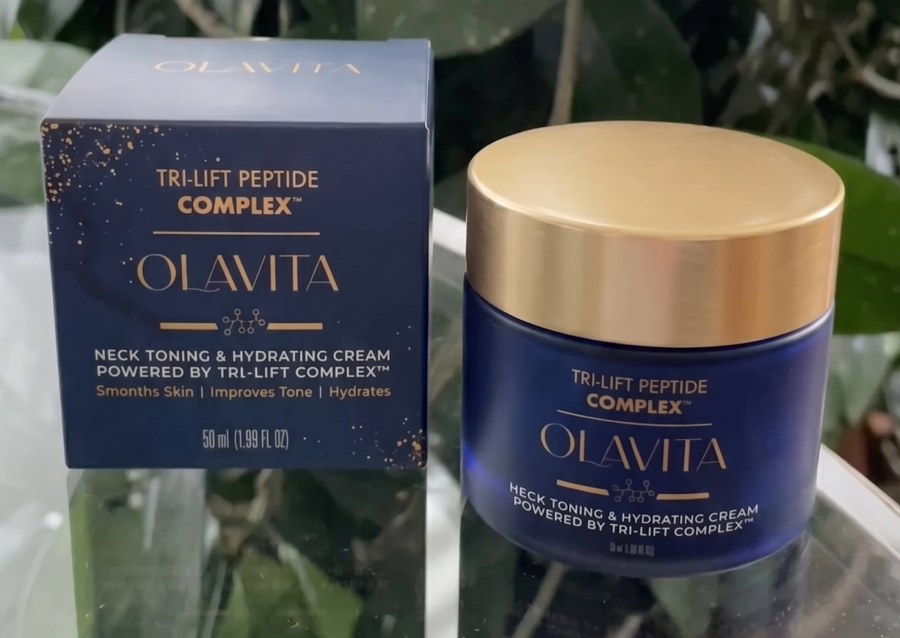
It is called Olavita Tri-Lift Peptide Complex, and it is built for the areas most
anti-ageing ranges ignore — the neck, the chest, the arms, the hands, the inner knees. Grace described
it not as another thick cream but as three jobs in one jar.
STEP ONE
Soften the look of the crease
The first job is the repeated folding that makes arms and necks look papery. Syn-Ake is a peptide used to
ease the surface tension associated with visible creasing, which is why the smoothing shows up as a
texture change rather than as weeks of waiting to feel moisturised.
Syn-AkeSTEP TWO
Support the structure beneath
The second job is the deeper support that makes younger skin look thicker. Syn-Coll — palmitoyl
tripeptide-5 — is a signal peptide studied for supporting collagen synthesis, paired here with
Matrixyl 3000. Grace's version: it tells the rebuilding crew to come back to work.
Syn-Coll · Matrixyl 3000STEP THREE
Stop it evaporating again
The third job is the barrier. Think of skin cells as bricks and ceramides as the mortar — when the
mortar breaks down, moisture escapes and every crease sharpens. Centella asiatica, or tiger grass, calms
the look of stressed skin while ceramides help seal the moisture in.
Tiger grass · Ceramides
What the numbers do and don't mean
The figures attached to these peptides — improvements in skin texture over 28 days, increases in
collagen synthesis in laboratory models — come from studies run by the ingredient suppliers on the raw
actives, not from trials of this finished cream. They are a reason to take the ingredients seriously. They
are not a prediction of what a jar will do on your arms.
Why I nearly didn't bother
Because I had been disappointed too many times. An $89 firming cream that felt luxurious and changed nothing.
Six months of stirring collagen powder into my coffee. A $600 at-home radiofrequency gadget currently living
under a stack of towels. My friend Gail spent $3,000 a session, four sessions deep, on in-office treatments
— and watched the looseness return after about eight months.
So when Grace handed me the jar I thought: another cream. Then she said the thing that made me pause.
“Don't judge it by how it feels on your fingertips. Judge it by the four places you just looked at in
the mirror.”
She told me to use it consistently for ninety days on my arms, neck, chest and hands. Not one dab on my face.
Not three applications and a verdict. Ninety days — long enough to give a formula a fair hearing. It
also came with a ninety-day money-back guarantee, which made the decision easier than it had any right to be,
given how much I had already spent on things that offered no way back.
Ninety days, written down
I decided to treat it as an experiment rather than a hope. I photographed both arms under the same bathroom
light, along with my hands, neck and chest, and wrote down what I noticed each week. The routine took about
thirty seconds: after cleansing, one pump into the area, massaged in. The texture is rich without being
greasy, and it didn't leave a film on my clothes.
Day 1
Softer — which proves nothing
My skin felt softer almost immediately, and I refused to be impressed. Any cream can do that for a few
hours. The only thing I noted was that it felt more cushioned than slippery, which was at least a
different sensation.
Day 5
Tom noticed before I said anything
My husband looked at my arms across the breakfast table and said they looked good. Tom does not notice
skincare; he barely notices a haircut. I went straight to the bathroom, turned on the overhead light I
usually avoid, and found the crepey texture still there — but less crumpled. More even.
Week 2
The comparison photo settled it
I put the new photograph beside the first one. The difference wasn't the kind of thing I could pretend
not to see: the arm looked smoother and less like crushed paper, and my chest looked less dry and less
lined.
Week 6
The neck, finally
The neck was the slowest of the four and the one I cared most about. Around week six the horizontal lines
looked softer in ordinary light — not gone, softer. I stopped reaching for a scarf on days I hadn't
planned to wear one.
Day 90
Sleeveless, at a pool, on purpose
I would not tell you my arms belong to a forty-year-old. They don't. What changed is that I stopped
auditing them. In August I wore a sleeveless dress to a family lunch and only realised afterwards that I
hadn't thought about it once, which is a stranger and better result than any photograph.
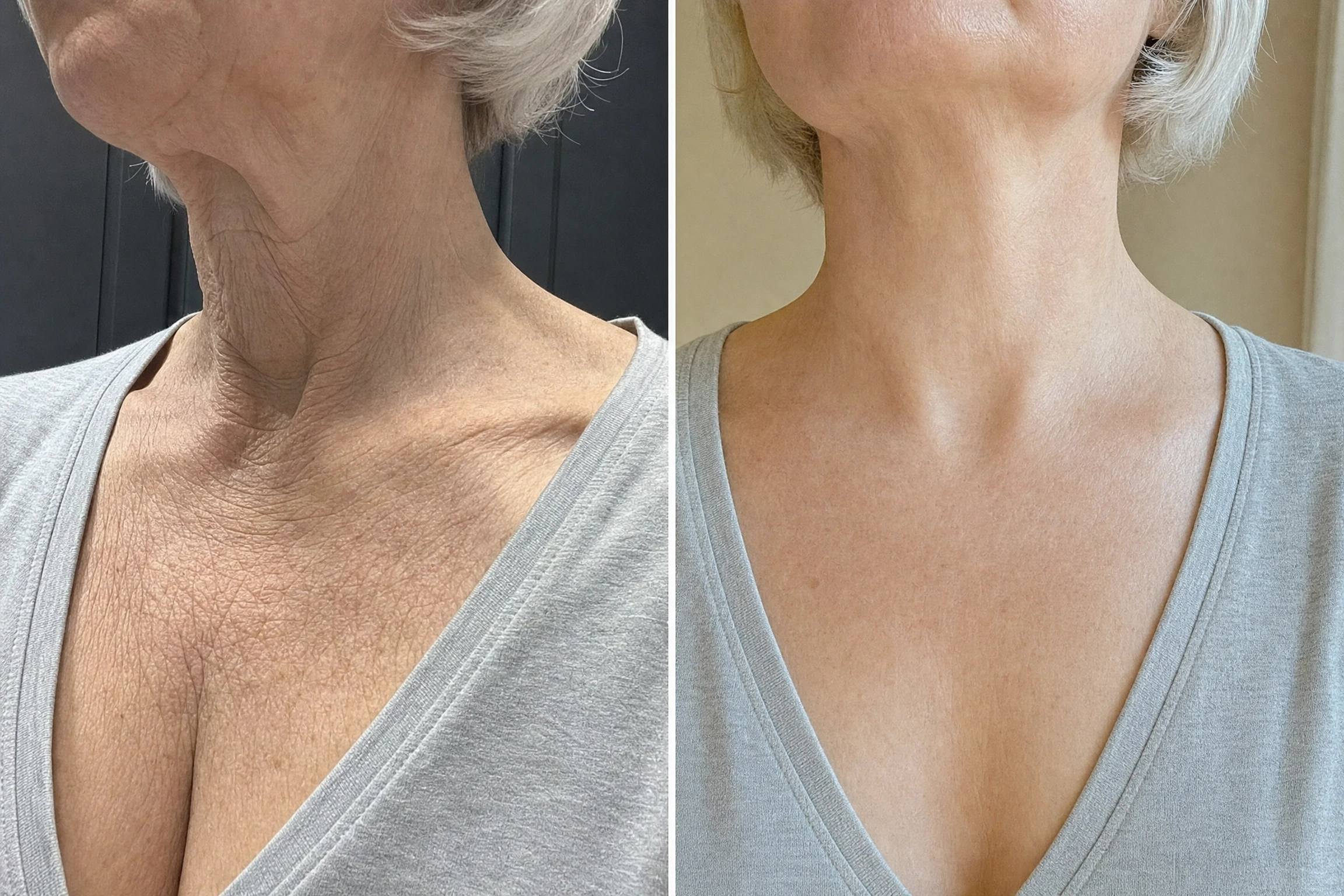
Before◆After
Manufacturer-supplied comparison photographs. Lighting, camera and posture affect how skin appears
in any such pair, and one person's result is not a forecast of anyone else's.
What I would tell you honestly
This is a cosmetic cream. It works on how skin looks and how well it holds moisture. It does not do what an
injectable does, it does not do what an energy-based device in a clinic does, and anybody selling it to you as
equivalent to either is overselling it. What it did for me was make four areas I had been hiding look and feel
enough better that I stopped hiding them.
Whether it does that for you depends on your skin, your age, how dry the air is where you live, and whether
you actually use it for long enough. Mine took the full three months to be worth the money. Yours might not,
and I'd rather say that than pretend otherwise.
From the brand's own store
What other buyers wrote
Reviews published by Olavita and reproduced here. Individual experiences differ, and these have not been
independently verified by Secret Beauty Stories.
“Most firming creams sit on top of the skin. A very small amount of this goes a long way, and it
doesn't feel like anything is on my arms at all.”
Mariah J.Chicago, Illinois
“I was loyal to the same big brand for years and felt disloyal switching. My skin is undeniably
smoother and softer now, so I got over it.”
Linda B.San Diego, California
“I've tried a lot of expensive creams and this one beat them. A pea-sized amount covers a lot, so
the jar is going to last me a while.”
Alexa R.Boca Raton, Florida
Where to find it
Olavita Tri-Lift Peptide Complex
A 50 ml jar of neck, chest, arm and hand cream built around the three peptides described above. Sold
directly by Olavita; a discount is running on the official site at the time of writing.
See current priceDiscount live
Package pricing, the size of any discount, shipping cost and availability are set by
Olavita and can change at any time without notice to us. The official checkout page is the only
authoritative source — confirm the figure before you pay.
90-day money-back guarantee. Olavita's published policy allows a return within ninety
days — the same period Grace told me to give it. The terms in force when you order are the ones
that apply.
The body areas most anti-ageing ranges quietly ignore: the neck, the chest and décolletage, the
inner upper arms, the backs of the hands, and the inner knees. It is a body-area cream rather than a
facial treatment, which is the whole point of it.
How long before anything is visible?
Texture tends to shift first and structure much later. The supplier studies behind the peptides report
visible texture improvement across roughly four weeks. Ninety days of consistent use is the fair test
— which happens to be the length of the guarantee, and is the timeline I used.
Is this an alternative to injectables or in-office treatments?
No, and I would be wary of any page that says otherwise. A topical cream does not do what an injectable
or an energy-based device does. This is a daily skincare step aimed at the appearance and hydration of
the skin surface, not a substitute for a clinical procedure.
What is actually in it?
The three named actives are Syn-Ake for the look of surface creasing, Syn-Coll (palmitoyl tripeptide-5)
alongside Matrixyl 3000 for the appearance of firmness, and Centella asiatica with ceramides for barrier
support. The full ingredient list is printed on the jar — read it before you use it, particularly
if you react to fragrance.
Is it safe for sensitive skin?
Most people tolerate peptide creams well, but nobody can promise that about your skin. Patch test a
small area first, keep it away from broken or irritated skin and away from the eyes, and stop using it
if you develop redness, itching or a rash. Speak to a dermatologist if you have a diagnosed skin
condition.
What if it does not work for me?
Olavita publishes a 90-day money-back guarantee. Returns and refunds are handled entirely by the seller
— Secret Beauty Stories has no access to orders and cannot process them. Read the return terms on
the official site before paying.
These sources concern the individual peptides, several of them via
the ingredient manufacturers themselves. None of them is a clinical trial of the finished Olavita cream, and
they should not be read as one.
Ninety days is the honest test
Package options, the current discount, shipping and the full return terms are all published on Olavita's
own site. That is the page to read before deciding — not this one.
This page is a paid advertorial published by secretbeautystories.com. It is promotional
content, not independent journalism and not medical or dermatological advice. Product links are affiliate
links and we may be compensated on purchases made through them. See our Advertising Disclaimer and Privacy Policy.
A note on skin and claims
Olavita Tri-Lift Peptide Complex is a cosmetic product. It is not a drug, it is not intended to diagnose,
treat, cure or prevent any disease or condition, and statements about it have not been evaluated by the Food
and Drug Administration. Cosmetic creams act on the appearance and hydration of the skin's surface; they do
not replicate injectables, lasers or surgery.
Patch test before first use, avoid broken or irritated skin, and discontinue use if irritation develops. If
you have a diagnosed skin condition, are pregnant or nursing, or notice a new, changing or non-healing mark
on your skin, speak to a doctor or dermatologist rather than relying on a cosmetic product.
We use cookies to keep this site working and to understand how it is used. You can accept or decline
non-essential cookies. See our Privacy Policy.